sat suite question viewer
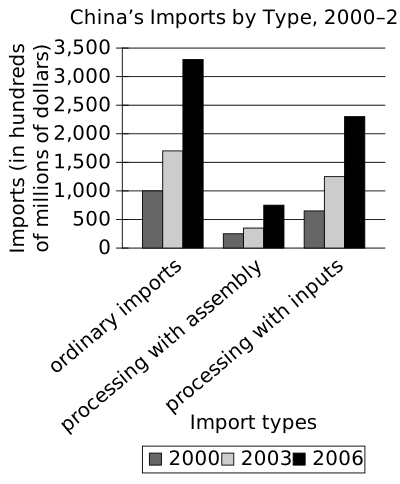
- For each data category, the following bars are shown:
- 2000
- 2003
- 2006
- All values are approximate.
- The Imports data for the 3 categories are as follows:
- ordinary imports:
- 2000: 1,000 hundred million dollars
- 2003: 1,700 hundred million dollars
- 2006: 3,300 hundred million dollars
- processing with assembly:
- 2000: 250 hundred million dollars
- 2003: 350 hundred million dollars
- 2006: 750 hundred million dollars
- processing with inputs:
- 2000: 650 hundred million dollars
- 2003: 1,250 hundred million dollars
- 2006: 2,300 hundred million dollars
- ordinary imports:
A student is researching the Chinese government’s 1992 shift to a market economy that emphasizes trade liberalization. One means of trade liberalization involves expanding from ordinary imports into an emphasis on processing imports, which have two types: processing with assembly (in which a firm obtains raw materials from a foreign trading partner without payment and sells the final goods to that partner, charging for assembly) and processing with inputs (in which a firm expends capital to buy raw materials from a trading partner, processes them into final goods, and sells those goods to whichever trading partner it chooses). The student asserts that while initial efforts at trade liberalization were shaped by Chinese firms’ limited capital, this situation resolved during the 2000s.
Which choice best describes data from the graph that support the student’s assertion?
Explanation
Choice B is the best answer because it describes data from the graph that best support the student’s assertion that initial efforts at trade liberalization in China were shaped by firms having limited capital (assets available for use) and that this situation resolved during the 2000s. The text explains that an approach to trade liberalization involves engaging in processing imports, one type of which doesn’t require payment to a trade partner (processing with assembly) and one type of which requires upfront payment to a trade partner for raw materials (processing with inputs). The graph, which presents China’s imports for ordinary imports and both types of processing imports in the years 2000, 2003, and 2006, shows that while processing imports with assembly rose from about 250 hundred million dollars in 2000 to about 750 hundred million dollars in 2006, processing imports with inputs rose much more sharply, increasing from approximately 650 hundred million dollars in 2000 to about 2,300 hundred million dollars in 2006. Because processing with inputs requires firms to pay for materials (expending capital) and processing with assembly doesn’t, the sharper rise in processing imports with inputs suggests that Chinese firms’ assets—and thus their ability to engage in that type of processing imports—were relatively limited in (and before) 2000 and then substantially increased from 2000 to 2006. In other words, the data suggest that the situation of having limited capital resolved during the 2000s.
Choice A is incorrect because the graph indicates that ordinary imports were greater than both types of processing imports in 2006, not that processing imports with inputs were greater than ordinary imports and processing imports with assembly that year. Choice C is incorrect because the observation that ordinary imports were greater than both types of processing imports in 2000, 2003, and 2006 doesn’t address a change within any type of imports from 2000 to 2006, and an indication of a change in that period that might be related to the availability of assets is needed to support the assertion that the situation of having limited capital resolved during the 2000s. Choice D is incorrect because the fact that processing imports with assembly were greater at the end of the period from 2000 to 2006 than processing imports with inputs were at the start of the same period doesn’t address a change within either type of imports during the period, and an indication of such a change that might be related to the availability of assets is needed to support the assertion that the situation of having limited capital resolved during the 2000s.